Tuning
Your guitar must be in tune or it wont sound any good no matter how well you play. The mechanics of tuning are easily explained but the ability to hear when a note is sharp or flat takes longer to develop.
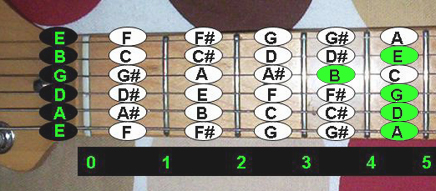
Each string is 5 frets apart except the B string which is only 4 frets higher than the G string as shown in the following diagram.
The problem with this style of tuning is that any errors are passed on to the next string and so on. Because the highest and lowest strings and both E you can compare them together when you finish tuning to see if they are OK. Although the high E string is two octaves higher you should still be able to hear if they sound in tune or not. You can also tune using harmonics.
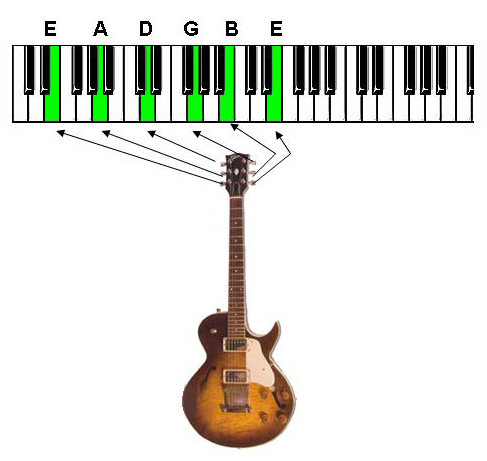
The following diagram shows how the guitar strings correspond with the notes on a keyboard which is another good way to keep in tune. You may not have access to a keyboard so you can hear these notes by clicking on each note which has been highlighted in green.
Music stores also sell electronic tuners and tuning forks. Virtual tuners are software applications which allow you to tune through your computer.